Unauthorized Solar Loan: What to Do If You Never Agreed
By Solar Exit IQ · Published October 6, 2026
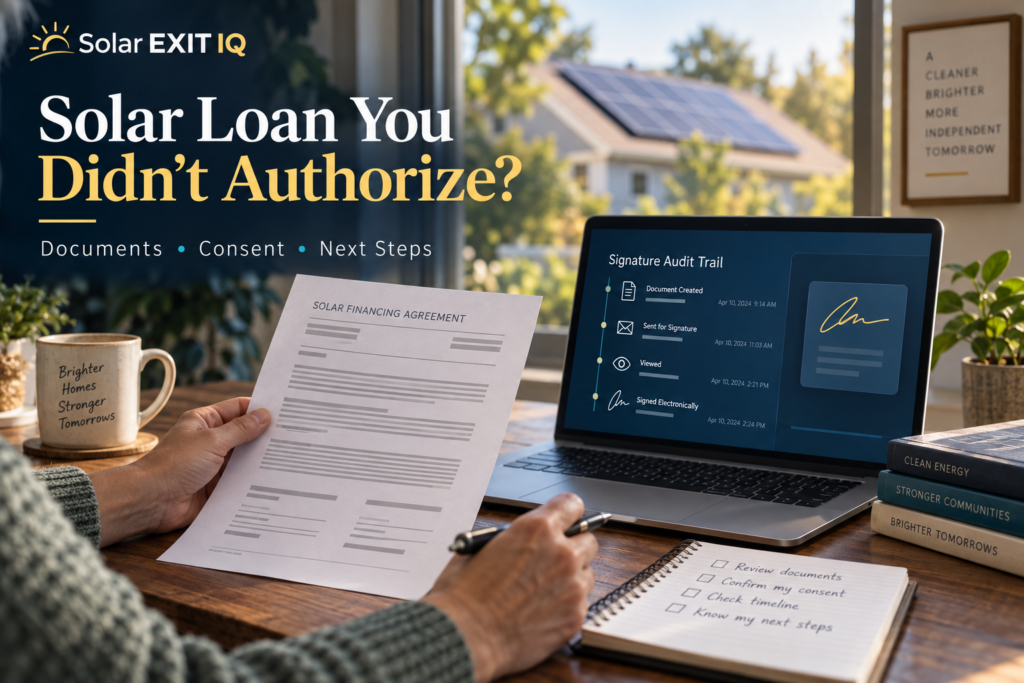
An unexpected solar payment notice can turn an ordinary day into a scramble: whose loan is this, where did the signature come from, and why is a lender saying you agreed? If you suspect an unauthorized solar loan, start by preserving the documents and disputing the specific consent problem. A sales conversation, roof inspection, or proposal is not enough information to establish what financing you actually authorized.
Your next steps depend on whether someone used your identity without permission, a salesperson misrepresented documents you signed, or a familiar loan simply appears under an unfamiliar company name. This guide explains how to sort those situations, request electronic signature records, and prepare for a review of potential resolution options.
Why unauthorized solar financing deserves attention in 2026
Recent court records show that solar consent disputes remain a current homeowner concern. In a July 23, 2026 memorandum in Owuor v. SunnyMac, a federal court described homeowners’ allegations of forged signatures, a purported free solar program, and financing they said they had not authorized. The court dismissed the federal credit-report-access claim without prejudice under controlling circuit precedent and allowed further proceedings concerning amendment and possible remand. It did not establish that the alleged forgery occurred or order blanket loan cancellation. Read the court memorandum.
The practical lesson is to separate the issues. Whether a company had a permissible purpose to access a credit report, whether you agreed to borrow, and whether a signature is authentic are different questions. A headline or another homeowner’s lawsuit cannot determine the answer for your agreement.
Is it an unauthorized solar loan or a different dispute?
You never applied for or approved financing
If you did not apply, sign, or authorize anyone to borrow in your name, tell the lender exactly that. Identify the account and disputed documents. Note when you first learned of the loan and what interaction, if any, you had with the solar seller. Ask the lender to route your concern to its fraud or investigation department.
You signed something, but were told it was only a survey
A homeowner who tapped a tablet after being told it was an inspection form has a different factual story from someone who never touched the device. Explain what the salesperson showed you, what was said, and whether you could read or download the document. Preserve the proposal and messages. Our guide to solar sales misrepresentation explains how to compare a sales statement with the written record.
You recognize the loan but not the servicer
A servicing transfer, lender trade name, or account assignment can explain an unfamiliar statement. Verify the company through an independently obtained contact channel and compare the original account number, system address, and balance. An unfamiliar name alone does not prove identity theft. If the account is yours but the payment or balance is wrong, identify that error rather than reporting the entire transaction as unauthorized.
Request the complete loan and electronic signature file
A signature image is only one part of the record. Request the documents and supporting information from both the financing company and the seller. Keep a copy of each request and its delivery confirmation. Ask for preservation of the original electronic records while your dispute is reviewed.
- Complete agreements: the loan application, executed loan agreement, credit disclosures, installation contract, amendments, and any authorization forms.
- Signature history: the completion certificate, envelope or transaction identifier, timestamps with time zones, and available signing-event records.
- Delivery and verification: the email address and phone number used, available authentication records, and the method used to verify the signer.
- Funding history: disbursement dates, recipients, and any completion certificates or homeowner approvals used to release funds.
- Communications: available welcome-call recordings, sales notes, and notices showing when the loan documents were sent.
Not every company will hold every record or provide it upon an informal request. If information is unavailable, ask which entity holds it and what process applies. Avoid treating a missing record as automatic proof that the loan is invalid.
Compare the records with your own timeline. A wrong email address, signing time when you were elsewhere, or misspelled name is worth identifying. Each is a clue to investigate, rather than a conclusion by itself. Shared household devices, forwarded emails, and time-zone differences can complicate the comparison.
Send a focused written dispute to the lender and installer
Phone calls can start the process, but a written account helps preserve your position. Send your concern through the company’s verified dispute or fraud channel. The financing company needs the loan-consent issue; the installer needs the related sales and project facts. Keep those requests consistent without assuming one company will notify the other.
Our solar loan dispute letter outline can help organize the facts. For a consent dispute, a starting paragraph might look like this:
“I dispute authorization of the solar loan identified as [account reference]. I first learned of it on [date]. I did not [apply for this loan/sign the identified agreement/authorize the named person to sign for me]. Please investigate, preserve the application and electronic signature records, provide the documents relied upon, and explain your determination in writing.”
Use only statements that accurately describe your experience. If you signed a document but dispute how it was presented, replace the denial with that explanation. Attach relevant copies, retain originals, and submit sensitive identity documents only through a verified secure process.
Ask separately whether the company will pause billing, collection activity, automatic withdrawals, or adverse credit reporting during its investigation. Request written confirmation of any arrangement, its duration, and its conditions. Sending a dispute does not itself establish that payments or other obligations are suspended.
Address identity theft and credit reporting separately
If someone used your identity without authorization, the FTC’s IdentityTheft.gov offers a reporting and recovery process. Describe events truthfully. A disputed sales promise or unaffordable agreement is not automatically identity theft.
The CFPB’s identity theft guidance explains fraud alerts, security freezes, and requests to block fraudulent credit-report information. A freeze helps restrict new credit access; it does not cancel an existing solar loan. A request to block information requires supporting documentation and is intended for identity-theft debts.
If the loan appears inaccurately on your credit reports, follow the CFPB’s credit-report dispute instructions. Contact each reporting company showing the error and the company furnishing the information. Identify the account, explain what is wrong, attach supporting copies, and retain the investigation responses. Credit-report correction and resolution of the underlying contract should be tracked as separate tasks.
Create a simple folder for each recipient: lender, installer, credit reporting company, and regulator. Record the submission date, confirmation number, requested response, and actual response. This makes it easier to see whether a reply addressed authorization or merely repeated the account balance.
What if panels are already installed or payments have started?
Installation adds practical questions about equipment, roof condition, utility approvals, and any property filing. Photograph the current condition and preserve project records. Do not remove panels yourself or assume returning equipment will resolve financing. Ask how any proposed resolution addresses removal, roof repairs, loan closure, and credit reporting.
If payments have already been made, retain bank statements and ask the company to explain how it will handle those amounts if the investigation supports your dispute. Speak with your bank promptly about withdrawals you contend were unauthorized. Bank procedures and deadlines can differ, and changing an automatic payment instruction does not resolve the alleged debt.
Before making a decision about future payments, review what can happen if you stop paying a solar loan and obtain advice appropriate to your situation. A lender may continue treating an account as due while authorization is contested. Avoid relying on an oral promise that “everything is on hold.”
Illustrative homeowner scenario
A homeowner agrees to a roof assessment, then receives a loan welcome email. The attached agreement uses a phone number the homeowner does not recognize. The useful next step is to save that email, request the application and authentication records, and explain the limited permission actually given. The incorrect phone number strengthens the need for investigation; it does not establish the outcome. This example is fictional and is not a Solar EXIT IQ client result.
Escalation and potential resolution options
If the response does not address your evidence, identify the unanswered questions and request review by the appropriate department. Depending on the issue, possible channels include the lender’s fraud team, your state attorney general’s consumer-protection office, a contractor regulator, or a consumer attorney.
The CFPB complaint portal handles eligible financial-product complaints. Its current instructions require a direct dispute first when complaining about inaccurate information to a credit reporting agency. Follow the portal’s eligibility and submission instructions. A complaint can seek a company response; it is not a court decision or a promise of cancellation.
Possible outcomes to evaluate include correction of account records, a documented investigation, an agreed payment arrangement, negotiated resolution, or legal action concerning disputed consent. Obtain independent legal advice if you receive a lawsuit, arbitration demand, settlement release, or deadline-sensitive notice. The best path depends on the actual documents, facts, and applicable law.
Unauthorized solar loan FAQ
Can I cancel a solar loan I never signed?
You can dispute authorization and request investigation and appropriate relief. Whether cancellation follows depends on the evidence and applicable process. A company may contest your account of events. Our guide to getting out of a solar contract explains the broader questions to review.
Is an electronic signature automatically proof I agreed?
A displayed signature does not answer every question about who signed or what authority they had. Request the underlying records and explain the specific discrepancy. Electronic signatures can be valid; a dispute about their authenticity requires examination of the transaction.
What if a family member signed my name?
Identify who signed, what permission you gave, and any relevant authorization documents. Permission to speak with a salesperson and authority to enter financing may involve different facts. Obtain legal advice before assuming the family relationship resolves the question.
Does reporting identity theft erase the loan?
No automatic contract cancellation follows from making a report. Reporting supports the recovery process. The lender’s investigation, credit-report process, and any dispute over contract enforceability still need attention.
Can Solar EXIT IQ review a suspected unauthorized loan?
Solar EXIT IQ is a solar contract review and resolution company. Homeowners can have their situation reviewed and receive an analysis of potential options based on their documents and circumstances. Solar EXIT IQ is not a law firm and does not guarantee cancellation.
Start with the consent records and a clear plan
An unexpected solar loan deserves a specific, documented response. Preserve what you received, request the full signing file, state precisely what you did or did not authorize, and track financing, credit, and installation issues separately. These steps create a stronger basis for evaluating potential options.
For help preparing your documents, read our solar contract review guide. Ready to discuss your situation? Request a Solar EXIT IQ assessment and include the unexpected loan notice, agreements, signature records, and company responses. A review can help identify questions and potential next steps; it does not pause deadlines or guarantee a particular result.
Published October 6, 2026. Sources checked October 6, 2026. General homeowner information, not legal or financial advice. Court allegations are not findings of wrongdoing, and the cited memorandum is not a representation of the case’s latest docket status.