A claimed equipment interest
The financing statement describes collateral. The security agreement helps explain what equipment rights support the obligation.
Look for: the collateral description, parties, filing number and supporting agreement.
 Solar contract review & resolution
SOLAR EXIT IQ · HOMEOWNER EDUCATION
Learn how solar UCC filings work, how they can affect selling or refinancing your home, and what steps homeowners can take to address filing issues.
Understand the record. Prepare your next step.
Free guide. No purchase or account registration required.
A UCC-1 financing statement is a public notice of a claimed interest in described collateral, such as solar equipment. Read it with your agreement to understand the rights and obligations involved.
The Uniform Commercial Code is a framework adopted through state law. Article 9 addresses secured transactions: arrangements in which property supports payment or another obligation. A financing statement, often called a UCC-1, alerts other parties to a claimed interest. The loan or security agreement supplies the terms; the public notice does not, by itself, establish every right a company asserts.
Three documents answer different questions: the note explains the payment obligation, the security agreement identifies the collateral and related rights, and the UCC record shows what notice was filed. One contract may contain more than one of these functions. A lease or PPA can also involve a precautionary filing to protect a provider’s claimed equipment interest; its existence alone does not prove that you borrowed money.
For an example of enacted Article 9 provisions, see Texas §§ 9.203, 9.502 and 9.505. The law governing your transaction and filing may be a different state’s version.
The financing statement describes collateral. The security agreement helps explain what equipment rights support the obligation.
Look for: the collateral description, parties, filing number and supporting agreement.
A mortgage or other real-property lien has its own legal basis. A fixture filing can also raise land-record and priority questions.
Look for: the actual recorded document and the title or lender requirement.
| Term | What it means | What to inspect |
|---|---|---|
| UCC-1 financing statement | Public notice identifying a debtor, secured party and collateral. It can serve different purposes. | Initial record, collateral description and all amendments. |
| Equipment security interest | An interest in collateral that secures an obligation; often created in the security agreement. | Signed agreement, collateral grant and payment terms. |
| Fixture filing | A financing statement filed as a fixture filing for goods related to real property, meeting additional legal requirements. | County land records, legal property description and priority requirements. |
| Real-property lien | A claim against real property, such as a mortgage or a qualifying construction lien. These have different legal bases. | The actual recorded instrument and governing law; do not infer its scope from “solar lien.” |
| PACE assessment | Property Assessed Clean Energy financing repaid through a property assessment rather than an ordinary equipment loan. | Tax bill, assessment contract, payoff and title requirements. |
A fixture filing is not simply another name for every solar UCC-1. Article 9 distinguishes filing offices and content requirements. PACE needs a separate analysis; Fannie Mae’s guide treats it differently from equipment financing. See Texas §§ 9.501–9.502 and Fannie Mae Selling Guide B2-3-04 — solar panel requirements.
| Arrangement | What to check |
|---|---|
| Loan | Note, security agreement, balance and collateral rights. |
| Lease | Provider ownership, transfer/purchase provisions and any precautionary filing. |
| PPA | Electricity-purchase terms, equipment ownership and transfer/buyout provisions. |
| PACE | Assessment agreement and property-tax bill; different mortgage eligibility and payoff questions. |
An effective termination ends the effectiveness of the identified financing statement to the extent authorized under applicable law. It is not a receipt, a debt settlement, a release of every recorded instrument or permission to stop paying. A lender may agree to release collateral while retaining an unsecured payment obligation; a refinance accommodation may leave the original solar agreement in place.
Likewise, a canceled installation agreement does not necessarily cancel a separate funded loan or a provider’s ownership rights. Get written terms identifying each agreement, account, balance, equipment obligation and filing to be addressed. If a settlement involves multiple parties, confirm who is bound by it.
State Article 9 termination duties can depend on the collateral category and whether obligations or commitments remain. Florida’s § 679.513 is one example; it should not be converted into a blanket deadline for every solar arrangement. For a legal dispute, have a licensed attorney evaluate applicable law and authorization.
Coordinate provider approval, payoff or transfer, and the exact title requirement.
Ask whether the condition concerns monthly debt, ownership, appraisal or priority.
Keep payment proof and filing-termination evidence as separate milestones.
Identify the disputed fact, request filing authority and preserve your evidence.
Confirm which debt, contract, equipment rights and recorded documents will change.
A lender or title company may need to determine ownership, loan payments, collateral rights and lien priority before approving a transaction. That review can create work even when the solar filing concerns equipment. An appraisal question and a title question are also different: a filing’s treatment does not automatically decide how much value panels add.
Fannie Mae’s solar panel guidance distinguishes separately financed panels, fixtures, leases/PPAs and PACE. It is mortgage underwriting guidance for covered loans, not a law requiring every homeowner to pay off every solar contract. Your lender must assess the actual documents and its own loan requirements.
A practical first question is: “Which specific record or contract clause prevents approval, and what written evidence will satisfy the condition?” That is more useful than asking for a generic lien release.
A homeowner pays off a solar loan before listing. The provider’s portal shows zero, but the title search still identifies a UCC record. The homeowner obtains the UCC-3 acknowledgment and asks title to match it to the initial filing. If a county fixture filing also exists, that record is checked separately. The goal is proof of the required filing action, not deletion of every historical search result.
| Document or action | Purpose | Responsible party / authority | Common homeowner scenario |
|---|---|---|---|
| UCC-1 financing statement | Initial public notice; a qualifying UCC-1 can also serve as a fixture filing. | Filer needs authority under applicable law. | Finding the initial record and collateral description. |
| UCC-3 amendment | Can document assignment, collateral changes or continuation. | Authorized party under applicable law and filing-office requirements. | A lender changes or a filing is continued. |
| UCC-3 termination | Ends effectiveness of the identified financing statement to the extent authorized. | Secured party of record commonly authorizes it; debtor-authorized filing is limited by law. | Verifying required termination after payoff or another qualifying resolution. |
A UCC-3 is not automatically a termination. Review the action selected, the initial filing number and the authorizing party. See the official UCC-3 instructions.
Find the loan, lease, PPA or assessment and identify who owns the system.
Obtain the initial record and linked amendments; check the relevant state and county records.
Match identities, collateral, agreement terms and the actual lender or title condition.
Payoff, correction, release, termination and subordination address different problems.
Identify who may authorize and submit the action. Send the specific record and evidence.
Retain acknowledgments and written account/contract terms; confirm each closing condition.
If you moved states, the lender changed names, or the record names someone else, ask a title professional or attorney to identify the correct search scope. A negative search under one name is not a legal opinion that no security interest exists.
| Record | Why it helps |
|---|---|
| Full signed agreement and addenda | Identifies ownership, collateral, transfer rights and notices. |
| Note, security agreement and current statement | Separates debt from filing status. |
| Initial UCC record and amendment chain | Identifies the exact record and authorized parties. |
| Title report and tax bill | Flags county records, other liens and possible PACE assessments. |
| Payoff or transfer quote | Shows conditions, good-through date and required approvals. |
| Proof of payment and written resolution | Supports follow-up without relying on a verbal promise. |
| Closing condition and contact list | Keeps the lender, servicer and title team working from the same request. |
The CFPB’s 2024 solar financing report documents consumer concerns about financing and sales practices. Use it as background; your signed documents and records are the evidence for your own situation.
| Your situation | Start here | Do not assume |
|---|---|---|
| You want a filing removed | Use the existing UCC release checklist. | Removal of the notice cancels the debt. |
| Loan paid in full | Verify UCC-3 termination after payoff. | A zero balance updates filing records automatically. |
| Home sale pending | Coordinate the solar UCC closing packet. | The buyer can assume a loan without approval. |
| Refinance pending | Clarify subordination and underwriting. | Every filing must be terminated before any refinance. |
| Authorization disputed | Document the filing dispute. | A complaint or information statement invalidates the record. |
| State law question | Check Florida, Texas and California filing guidance. | A rule from one state applies nationwide. |
State law, collateral classification and filing type matter. A rule from one state should not be treated as a nationwide deadline.
Florida § 679.513 distinguishes covered consumer-goods termination duties from other cases. Confirm the conditions and any required demand.
Review filing offices, authorization, termination and disputed-record provisions under the enacted Article 9 rules.
The Secretary of State explains filing locations, information statements and why an initial record may remain searchable after termination.
For other states, begin with their enacted Article 9, official filing-office guidance and applicable county recording procedures. Use the Resources hub for related state contract guides; cancellation rights and filing termination are different questions.
It can prompt title or priority review, especially when a fixture filing is in land records. It does not automatically mean the homeowner has a traditional mortgage lien. Review the filing, agreement and transaction requirements.
Possibly. The provider, buyer’s lender and title team may require payoff, approved assumption or transfer, subordination or other documentation. A buyer’s promise to pay does not, by itself, release the seller.
Possibly. Identify whether the lender’s condition concerns debt, ownership, appraisal or priority. Subordination and termination address different issues, and PACE has separate eligibility considerations.
Ask title or the filing office for the full initial record and its linked amendments. Search the applicable state UCC index and check county land records where fixture filings may be involved.
Obtain written account satisfaction and any required termination or release evidence. A zero balance does not automatically update public filing records. Match the acknowledgment to the initial filing number and check separate county records.
A party with authority under applicable law. The secured party of record commonly authorizes it. Debtor-authorized termination is limited by law and stated conditions; submitting the form is not a shortcut around those rules.
Yes. Identify the exact discrepancy, request the records supporting filing authority and preserve your evidence. A UCC-5 information statement does not itself terminate or invalidate the financing statement.
No. A financing-statement action and the underlying debt or agreement are separate questions. Obtain written terms addressing each relevant account, contract, equipment obligation and filing.
There is no universal timeline. Applicable state law, collateral classification, remaining obligations, receipt of a qualifying demand and filing-office processing all matter. Ask for written procedures and have individual deadlines reviewed by a licensed attorney.
Understand your filing, learn your options, and prepare your next steps with our easy-to-follow homeowner guide.
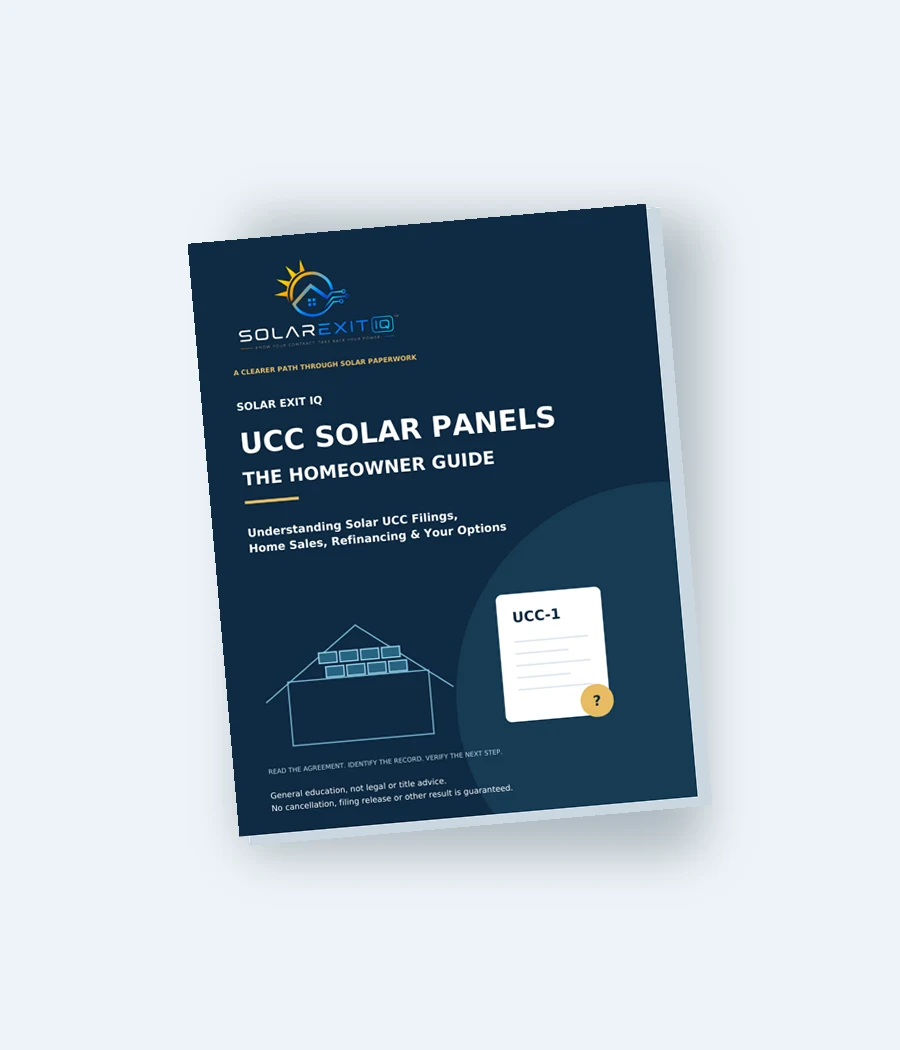
Educational information. No specific legal or financial outcome is guaranteed.
Keep a copy with your solar agreement and filing records. This request does not enroll you in a promotional sequence.
Use the existing analyzer to organize the issues you report and identify questions for review. It does not provide a legal opinion or determine cancellation eligibility.
Learn about the program for homeowners who want to organize records, prepare correspondence and manage their own follow-up.
See how Solar EXIT IQ helps organize agreement, financing, performance and property concerns for an initial review. Availability depends on the matter.
Solar EXIT IQ is not a law firm and does not provide legal, title, tax or mortgage advice. This material is educational and does not create an attorney-client relationship. A licensed attorney should evaluate individual rights, deadlines, authorization and remedies. No cancellation, filing release, closing, savings or other result is guaranteed. Read the service disclaimer.
Sources checked October 14, 2026. State law and mortgage guidance should be rechecked for individual transactions. The HTML explanations remain available on this page without requesting the PDF.